
Houthis are back
Four ways to move Saudi crude out of Yanbu

This weekend, the US and Iran paused their direct exchanges after two weeks, and you’d think that means things are cooling off. Instead, on a separate front, the Houthis went ahead this weekend and hit Saudi Arabia directly, their first strike on Saudi oil infrastructure since 2022, after declaring a naval blockade against Saudi Arabia last week. Whatever is happening between Washington and Tehran, the Houthis are clearly following their own logic.
Early Saturday, Houthi missiles and drones struck Jizan while attempting to hit Yanbu. The Jizan refinery caught fire. At Yanbu, two ballistic missiles aimed at the oil installations there were intercepted. The Houthis framed it as retaliation for Saudi strikes on Hodeidah and Kamaran Island.
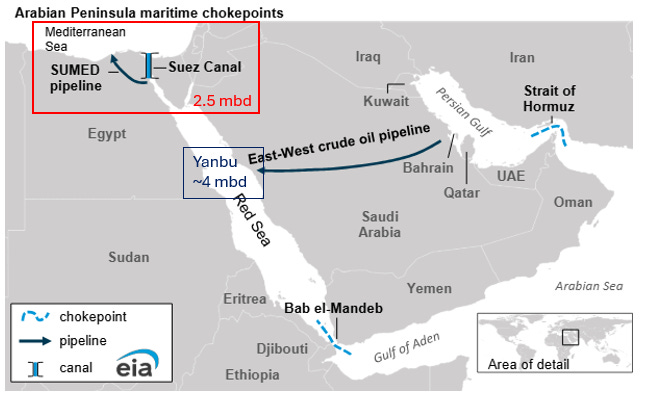
Yanbu is the part that should make everyone pay attention, and it’s already been the center of the story for a couple of weeks now. Once the Houthis declared their blockade against Saudi Arabia and blocked the direct route out through Bab-el-Mandeb, Yanbu became the only place Saudi Arabia could still push its Red Sea crude, roughly 3.5 to 4 million barrels a day, nearly all of it bound for Asia. It is now handling around 92% of Saudi Arabia’s seaborne crude exports right now, basically the country’s only real way to move crude out by sea with Hormuz effectively closed as well. Which is why, before this weekend, most of the conversation around Yanbu was a plumbing problem rather than a supply problem.
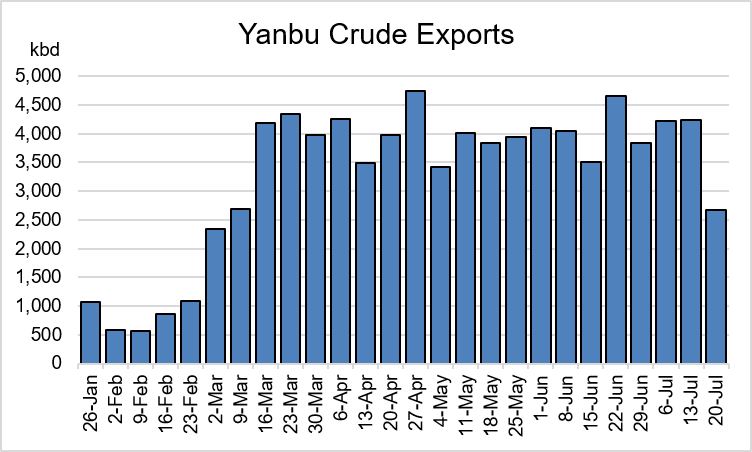
And it really is a very interesting plumbing problem, because it explains why there’s a 1970s pipeline suddenly back in the news. SUMED exists because of an earlier version of this same situation.
The Suez Canal was closed for eight years after the 1967 war, and while it was closed the industry built bigger vessels to make the long way around Africa with a lower cost per barrel. By the time the canal reopened in 1975, a big chunk of the world’s tanker fleet had grown into VLCCs too deep to fit through it anyway. So a consortium of Egypt, Saudi Aramco, Kuwait, the UAE and Qatar built a pipeline instead, Ain Sukhna on the Red Sea side to Sidi Kerir on the Mediterranean side, roughly 320 kilometers, which has been operating since 1977 with a capacity of around 2.5 million barrels a day. It already had one moment earlier this year, back in March, when Egypt’s own oil minister publicly offered it up as a release valve once the Strait of Hormuz shut. With Bab-el-Mandeb blocked too, it stopped being a convenient option and became one of the only ways out.
The reason this pipeline is needed is that a VLCC fully loaded cannot transit the Suez Canal, because of its draft. So getting Yanbu crude to Asia the long way around means solving that problem first, and there are basically four ways:
One VLCC can shuttle between Yanbu and Ain Sukhna, discharging into the pipeline, while a second VLCC sits at Sidi Kerir on the Mediterranean side loading the cargo before heading off around the Cape. Looks like a great idea, except the Mediterranean isn’t a VLCC trading region day to day, so finding that second ship means either getting lucky or ballasting one in from the Atlantic, which can take weeks, and either way you’re capped by the pipeline’s 2.5 million barrel a day ceiling.
Or a single VLCC can do the job, loading at Yanbu, discharging just enough (around 800.000 barrels) at Ain Sukhna to get under the Suez draft limit, transiting the canal lightered, then picking the same crude back up at Sidi Kerir once it’s come through the pipeline, before topping up its cargo again before heading out around the Cape. Same ship the whole way, no second VLCC needed, and the pipeline gets used about as efficiently as it can be.
Or a VLCC part loads at Yanbu and transits Suez lightered like above, but instead of using the pipeline, an Aframax carries the rest through the canal on its own, since an Aframax doesn’t have the draft problem, and the two meet up in the Mediterranean to do a ship-to-ship transfer. This one skips the pipeline capacity question entirely, but you’re paying for two ships & Suez Canal tolls plus the STS itself. Very expensive.
Or you just charter Suezmaxes directly, since they can transit the canal fully loaded with no lightering and no pipeline involved at all. It is the simplest option operationally if the Suezmaxes do the full voyage to Asia, but more expensive than the first and second option by my numbers. You could also do an STS in the Mediterranean Sea from two Suezmaxes to a VLCC, but this option is also expensive.
I have already seen two vessels on subs for the first option (the first one at $17m lumpsum from Sidi Kerir to Korea) and I guess that we could end up seeing both the first and fourth options being used simultaneously in different proportions depending on the charterer and the vessel availability.
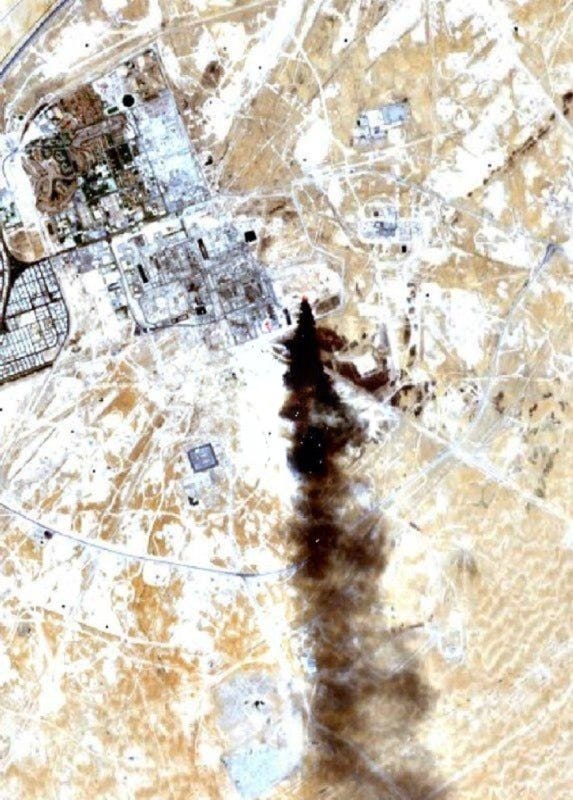
Today, the situation escalated again. Houthi and Iranian state media have begun reporting fires at Abqaiq, the largest crude stabilization and processing facility in the world.
Saudi Arabia’s own statement only confirmed intercepting drones launched from Iraqi territory aimed at oil facilities, it didn’t confirm Abqaiq damage. The images going around show smoke and flaring, and flaring on its own doesn’t tell you a plant took real damage. So I treat the Abqaiq claims as a possibility for now, not as confirmed fact.
Everything about the four options assumed the crude itself, and the terminals loading it, are still working, that the problem is purely getting ships from A to B. That’s a cost problem, ugly but manageable, and worth understanding on its own terms. But the real question raised this is whether the Houthis have actually gained the capability to reach into Saudi Arabia’s oil infrastructure and materially affect its export capacity itself. If the answer is yes, this stops being a shipping story and becomes a supply story, and those are priced completely differently.